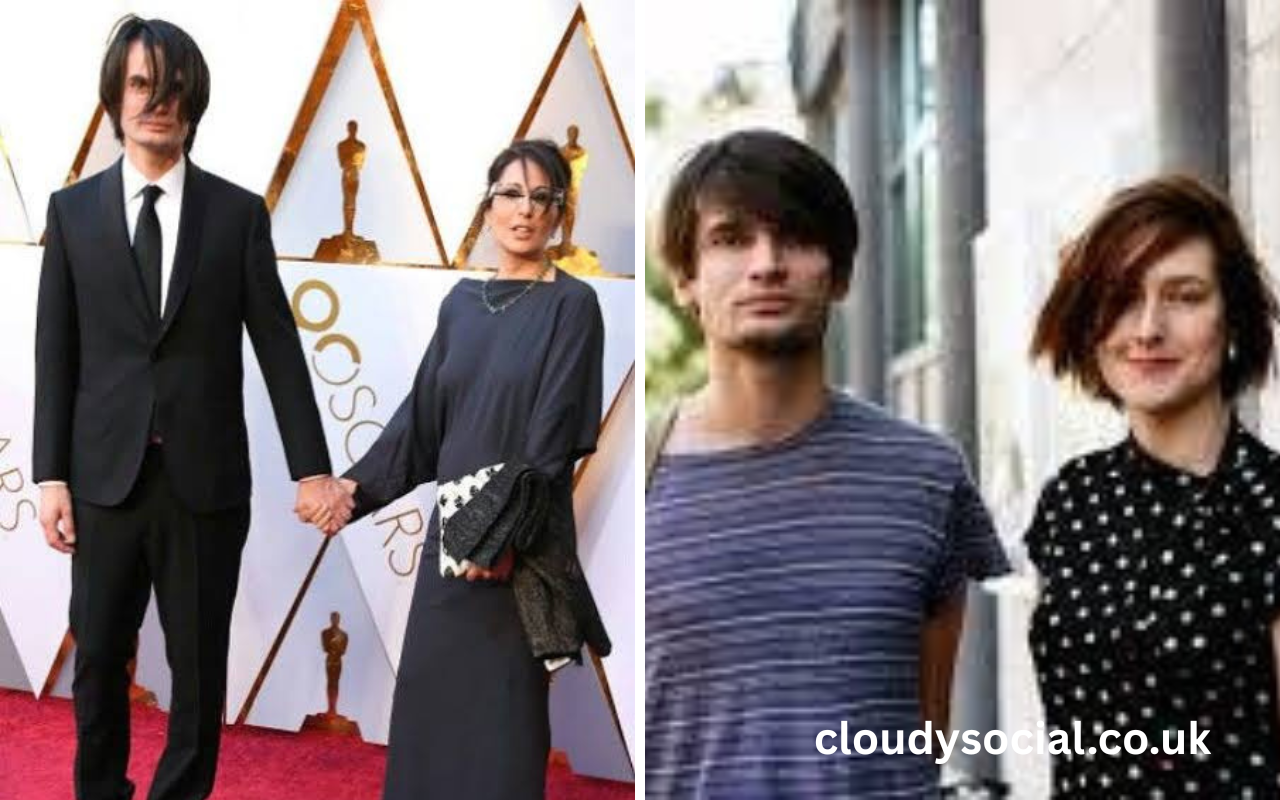
Sharona Katan is a British-Israeli visual artist, photographer, and creative director who works professionally under the name Shin Katan. Although she is widely recognized because of her marriage to Radiohead guitarist and film composer Jonny Greenwood, her own creative career extends across photography, photographic sculpture, album artwork, art direction, and international music projects. Her work has appeared alongside important film scores, collaborative albums, and cross-cultural artistic productions involving musicians from Britain, Israel, India, and other parts of the world.
Public interest in Sharona Katan often begins with her connection to Greenwood, but her professional identity is more substantial than the description “Jonny Greenwood’s wife” suggests. Through her portfolio, music credits, photographs, artwork, and involvement in projects such as Junun, Katan has developed a recognizable creative presence. She has also occasionally entered public political and cultural debates, particularly those concerning Israel, Jewish identity, antisemitism, artistic boycotts, and the role of cultural collaboration during periods of conflict.
Who Is Sharona Katan?
Sharona Katan, also known as Sharona Katan-Greenwood, is a visual artist and photographer who uses the professional name Shin Katan. British company records list her as having been born in May 1971, although a reliable public source confirming her exact date of birth has not been established. She has been described in arts and media coverage as an Israeli artist, while British corporate filings identify her nationality as British and her country of residence as the United Kingdom.
Katan’s work is primarily associated with photography, experimental visual art, and what she calls “photographic sculpture.” This description reflects an approach in which photography is treated not only as a flat image but as material that can be arranged, constructed, layered, presented, or transformed into a physical artistic object. Her portfolio includes independent visual projects, seasonal photography series, exhibition work, portraits, album covers, and creative collaborations connected to film and music.
She is not to be confused with Sharona Alperin, the woman who inspired the Knack’s famous song “My Sharona.” Sharona Katan is a separate person whose public identity is rooted in contemporary art, photography, music-related design, and her family connection to Jonny Greenwood.
The Meaning of the Name Shin Katan
Sharona Katan frequently receives professional credit under the name Shin Katan. This is the name used on her artistic website, in album credits, in promotional photographs, and in music-industry databases. As a result, people searching only for “Sharona Katan” may miss a significant portion of her professional work, which is documented under “Shin Katan.”
The use of a distinct artistic name allows her personal identity and her creative practice to overlap without being identical. In official music credits, Shin Katan appears as a photographer, artist, and art director. In media reporting and public discussions, she is more commonly called Sharona Katan or Sharona Katan-Greenwood. Both names refer to the same person, but the context usually determines which version is used.
Sharona Katan’s Artistic Style
Katan describes her artistic practice as photographic sculpture. The term suggests that her work moves beyond conventional documentary or portrait photography. Instead of treating a photograph only as a record of a person, place, or event, she explores how photographs can become objects, surfaces, arrangements, or components of a larger visual structure.
Her portfolio contains work dating back to at least the early 2000s. It includes photographic series associated with different seasons, later projects produced during the second half of the decade, and artwork created in connection with exhibitions and music releases. Some of the projects appear intimate and observational, while others are closely connected to the visual environments of films, recordings, and international musical collaborations.
The available material does not present Katan as a conventional commercial photographer with a large public client list. Instead, her career appears to be project-based and closely tied to artistic relationships. Her photographs often emerge from direct involvement with musicians, composers, filmmakers, and performers. This gives her work a personal and collaborative quality that differs from standard publicity photography.
Early Projects and Exhibition Work
Katan’s official portfolio documents several photographic projects from 2002, including bodies of work organized around seasonal themes. It also includes projects from 2007, 2008, and 2009, showing that her visual practice developed over a sustained period rather than appearing only after her involvement in major music releases.
She was also associated with Mannish Trousers, an Oxford-area group of artists. The name reflects the playful and unconventional atmosphere often found in independent artist collectives. Participation in a local art group placed Katan within a broader creative community rather than limiting her work to the music industry or to projects associated with her husband.
In 2010, she was involved in an exhibition titled Stilleven at the O3 Gallery in Oxford. The word “stilleven” is associated with still-life art, and the exhibition formed part of her continuing engagement with constructed images and photographic objects. Although a complete public record of all her exhibitions is not available, the documented projects show that her artistic activity includes gallery-based work as well as album and promotional photography.
Album Artwork and Film-Music Connections
A major part of Sharona Katan’s public artistic record is connected to album artwork and film scores. Her portfolio lists work associated with Bodysong, There Will Be Blood, Norwegian Wood, The Master, Inherent Vice, and the collaborative release featuring Jonny Greenwood and Polish composer Krzysztof Penderecki.
These releases are connected to some of Jonny Greenwood’s best-known work as a film composer. However, Katan’s involvement should not be understood as merely an informal family contribution. She received professional credit for visual material, photography, artwork, and related creative input. The final sleeve designs were often assembled by designer Dustin Stanton, but Katan contributed original imagery or source material used in the finished packaging.
Her work on these releases helped establish a visual connection between the music and the atmosphere of the films. Soundtrack artwork has a difficult role because it must represent both the identity of the recording and the emotional world of the motion picture. Katan’s photography and visual material contributed to that relationship, particularly on releases associated with director Paul Thomas Anderson and other internationally recognized filmmakers.
Her Contribution to Norwegian Wood
Katan received a specific artwork credit for the soundtrack album of Norwegian Wood. The film, directed by Tran Anh Hung, was based on the novel by Haruki Murakami, while Jonny Greenwood composed the score. The project required visual material capable of reflecting the film’s restrained, emotional, and literary atmosphere.
Under the name Shin Katan, she was credited with the soundtrack’s album artwork. This is one of the clearest examples of her receiving formal recognition for her creative contribution to a major international release. The credit also demonstrates how her visual work has operated alongside cinema and composition, creating an identity for music that listeners encounter independently from the film itself.
Sharona Katan and the Junun Project
One of the most significant projects associated with Sharona Katan is Junun, the 2015 collaboration involving Israeli musician Shye Ben Tzur, Jonny Greenwood, and the Rajasthan Express. The project brought together qawwali-influenced music, devotional traditions, Indian instrumentation, electronic textures, brass arrangements, and Greenwood’s experimental approach to composition and production.
Katan’s contribution was central to the project’s development. Official credits state that the original project was conceived by Sharona Katan. This means her role went beyond photographing the musicians after the collaboration had already been organized. She was credited with originating the idea that eventually became the album and documentary project.
The music was recorded at Mehrangarh Fort in Jodhpur, Rajasthan. The location gave the project a distinctive visual and acoustic identity. The musicians worked together inside the historic fort, combining different languages, traditions, instruments, and performance styles. Filmmaker Paul Thomas Anderson documented the sessions, producing the film Junun, which captured the energy of the recordings and the relationships among the participants.
Katan was also credited with art direction alongside Ian Patrick. In addition, she created the cover photography and artwork. Her responsibilities therefore included the original concept, the visual presentation, and the imagery through which the public encountered the album. This combination makes Junun one of the strongest examples of her influence as both an artist and a creative project originator.
Photography Connected to Paul Thomas Anderson and Jonny Greenwood
Katan has photographed figures connected to the overlapping worlds of music and cinema, including Jonny Greenwood, Shye Ben Tzur, Paul Thomas Anderson, and members of the Rajasthan Express. Her images have been used in promotional material and by record companies to represent projects involving these artists.
The relationship between Greenwood and Anderson has produced several acclaimed film scores, including There Will Be Blood, The Master, Inherent Vice, Phantom Thread, and The Power of the Dog. Katan’s creative work has intersected with this collaboration through album imagery, source photographs, promotional pictures, and the wider visual presentation of Greenwood’s film-related music.
Her access to the artists gives her photographs an informal quality that may be difficult for an outside photographer to reproduce. The people she photographs are often collaborators, friends, or family members rather than distant subjects. This familiarity can create images that feel less staged and more closely connected to the atmosphere of the creative process.
The Later Ranjha Collaboration
The musical relationship formed through Junun continued in later work involving Shye Ben Tzur, Jonny Greenwood, and the Rajasthan Express. The project Ranjha was presented as a reunion of the musicians and a continuation of their cross-cultural collaboration.
Promotional material connected to Ranjha credited Shin Katan for photography. Her continued involvement demonstrates that her contribution to the earlier project was not limited to a single album cover. She remained part of the visual and creative environment surrounding the musicians.
The continuing collaboration also reflects Katan’s broader interest in artistic exchange across national, religious, and cultural boundaries. The musicians involved come from different backgrounds, but the project is based on shared performance rather than on separating participants according to identity. This idea of collaboration later became important in Katan’s public comments about art, politics, and cultural boycotts.
Marriage to Jonny Greenwood
Sharona Katan is married to Jonny Greenwood, the guitarist, keyboard player, arranger, and composer best known as a member of Radiohead. Greenwood is also an acclaimed film composer who has worked extensively with Paul Thomas Anderson and other filmmakers.
Katan and Greenwood reportedly met during Radiohead’s first visit to Israel in 1993. Radiohead developed an early audience in Israel before achieving its full international reputation, and the country played an important role in the band’s early touring history. Multiple published accounts state that Katan and Greenwood married in 1995, although a primary public marriage record is not widely available.
The couple have three children. Their family has largely maintained privacy, and personal details about the children are not necessary for understanding Katan’s professional career. Public interviews and reports have nevertheless indicated that Jewish traditions have been present in the family home.
Jewish Identity and Family Traditions
Katan has spoken publicly about her Jewish identity and her family’s observance of Jewish traditions. She has said that the children were raised Jewish and that the family home includes a mezuzah. The family has also observed some Shabbat dinners and Jewish holidays.
Her background connects her to Middle Eastern Jewish history. In a personal essay, she described herself as the daughter of Egyptian and Iraqi Jews. She also wrote about a grandparent who was born in Jaffa in 1912. These details place her family history within the complex experiences of Jewish communities that lived across the Middle East and North Africa.
This heritage is important to understanding her political and cultural statements. Katan’s identity is not presented only as a connection to the modern state of Israel. It is also connected to older Jewish communities in Iraq, Egypt, and the region more broadly. Her writing emphasizes the experiences of Jews from Arab and Middle Eastern countries, whose histories are sometimes overlooked in simplified discussions of Israelis and Palestinians.
Sharona Katan’s Public Political Statements
Katan became more publicly visible in political debate after writing about Israel, antisemitism, cultural boycotts, and criticism directed at Jonny Greenwood. Her comments followed controversy over Greenwood’s continuing collaboration with Israeli musician Dudu Tassa and performances involving Israeli artists.
In a 2024 essay, Katan described herself as pro-peace. She discussed the October 7 attacks, antisemitism, the history of her Iraqi-Jewish family, and her objections to cultural boycotts. Her argument presented musical collaboration as a possible form of human connection rather than as an endorsement of every action taken by a government.
Her writing also criticized efforts to pressure artists into cutting ties with Israeli collaborators. She argued that cultural isolation can erase the complexity of individual identities and can discourage relationships between Jewish, Arab, Israeli, Palestinian, Indian, British, and other artists.
Katan’s statements have received both support and criticism. Supporters view her as defending artistic freedom, Jewish identity, and cross-cultural cooperation. Critics have argued that artistic projects can be used to soften or distract from political realities. Because the debate is highly polarized, descriptions of Katan often depend on the political position of the person discussing her.
It is therefore important to distinguish between Katan’s documented statements and labels applied to her by social-media users. She has publicly described herself as pro-peace and has defended continued artistic collaboration. More extreme ideological descriptions frequently seen online are interpretations rather than neutral biographical facts.
The Controversy Around Jonny Greenwood’s Israeli Collaborations
Jonny Greenwood’s connections to Israeli music have become a subject of debate because of his performances and recordings with Dudu Tassa and other musicians. Greenwood has rejected the idea that collaboration with Israeli artists should automatically be treated as support for the Israeli government.
Sharona Katan’s background has often been mentioned in discussions of Greenwood’s relationship with Israel. This can sometimes reduce her to a political explanation for her husband’s choices, overlooking her own artistic career and her direct role in international musical projects.
Her involvement in Junun is especially relevant because the project included musicians from different religions, nationalities, and traditions. For Katan, such collaboration appears to serve as evidence that artistic exchange should continue even when political relations are difficult. Her critics may disagree with that conclusion, but her creative record shows that the position is connected to projects she has personally helped build.
Sharona Katan’s Business Roles
In addition to her artistic work, Katan has held formal roles as a company director in the United Kingdom. British corporate records list her as a director of Unreliable Limited, with an appointment beginning in 2010. She was also appointed as a director of Shufra Di Shufra UK Limited in 2025.
Company-director records confirm aspects of her legal and professional identity, including her birth month and year, nationality, and country of residence. However, such records do not provide a full explanation of the companies’ day-to-day activities or of Katan’s specific responsibilities.
Corporate information should also be treated carefully because official registries often publish administrative filings rather than independently written biographies. The records are useful for confirming appointments and legal details, but they do not replace an artistic résumé or a detailed account of her career.
Her Relationship With Radiohead’s Public History
Sharona Katan is connected to Radiohead’s history through her marriage to Greenwood, but she is not known as a formal member of the band’s creative organization. She does not appear to have a general credit for Radiohead’s songwriting, performance, or principal album design.
Her connection is instead personal and indirect, although her artistic work overlaps with Greenwood’s solo compositions, film scores, and collaborative projects. This distinction is important because online biographies sometimes exaggerate the roles of partners or family members in famous artists’ careers.
Katan has contributed to specific projects for which she has received identifiable credit. Those contributions include photography, artwork, art direction, and project conception. Claims beyond those documented areas should be treated cautiously unless supported by reliable evidence.
Public Website and Online Presence
Katan’s primary professional website is published under the name Shin Katan. It presents her portfolio, including photographic sculpture, exhibition work, album artwork, and music-related images. The website offers the clearest direct view of how she defines her creative practice.
She has also published writing through Substack, although her publicly available archive is relatively limited. Her most widely discussed text focuses on Jewish identity, Israel, antisemitism, peace, artistic collaboration, and the controversy surrounding Jonny Greenwood’s work with Israeli musicians.
An X account using her name has also been associated with her public activity. The account includes posts related to art, music, Israel, Jewish identity, and political debate. As with any social-media profile, individual posts should be interpreted in their original context rather than used to make broad claims about a person’s complete beliefs.
Why Public Information About Sharona Katan Is Limited
Compared with major recording artists, actors, or celebrity personalities, Sharona Katan maintains a relatively low public profile. She does not appear to participate frequently in mainstream interviews, celebrity features, or extensive press campaigns centered on her personal life.
Her portfolio provides evidence of her work, but it is not organized as a detailed professional biography. It does not publicly establish a complete educational history, a full exhibition list, a record of awards, or a comprehensive list of clients. There is also no dependable public estimate of her wealth.
This limited documentation has created space for low-quality biography websites to repeat unsupported claims. Precise statements about her exact birthday, education, religion, net worth, or private relationships should not be treated as factual unless they can be connected to a reliable primary or professional source.
Sharona Katan’s Age and Date of Birth
Public corporate information records Katan’s birth month and year as May 1971. Based on that information, she turned or was due to turn 55 in May 2026. Her exact birthday has not been reliably established in the available public material.
Many celebrity-biography websites publish exact dates without explaining their sources. Unless an exact date is confirmed by Katan herself, an official record, or a dependable publication, the safest biographical wording is that she was born in May 1971.
Sharona Katan’s Nationality
Katan’s nationality is sometimes described differently depending on the source. British company records identify her as British and residing in the United Kingdom. Arts and media articles frequently describe her as Israeli or as a British-Israeli artist.
These descriptions are not necessarily contradictory. A person may have more than one nationality, may have been born or raised in one country while later becoming a citizen of another, or may be culturally identified with more than one place. However, the exact history of Katan’s citizenship has not been extensively documented in reliable public biographies.
It is therefore most accurate to describe her as a British-Israeli visual artist, while acknowledging that official UK corporate filings currently list her nationality as British.
Sharona Katan’s Religion
Katan has publicly identified with Jewish heritage and has discussed Jewish traditions in her family. Her writing refers to her Egyptian-Jewish and Iraqi-Jewish ancestry, and reports have described Jewish customs in the Greenwood-Katan household.
There is not enough reliable public information to assign her to a particular Jewish denomination. Labels such as Orthodox, Conservative, Reform, secular, or traditional would require evidence that is not clearly available. It is more accurate to say that Jewish identity, heritage, history, and family practice are important parts of her public self-description.
Sharona Katan’s Net Worth
No reliable public source provides a verified estimate of Sharona Katan’s personal net worth. Websites that assign precise figures to artists and celebrity spouses often use speculation, automated calculations, or assumptions based on a partner’s wealth.
Jonny Greenwood’s commercial success with Radiohead and his film-scoring career does not establish Katan’s personal financial worth. Marriage does not make every estimate of one spouse’s assets an accurate measure of the other spouse’s finances.
Katan has professional credits, artistic projects, and company appointments, but these do not provide enough public financial data to calculate her income or assets. Any exact net-worth figure should therefore be regarded as unverified.
The Importance of Her Independent Identity
Sharona Katan’s public image illustrates a common problem faced by artists who are married to more famous figures. Search results often prioritize the marriage while reducing the individual’s professional identity to a secondary detail.
In Katan’s case, the surviving evidence shows a distinct creative career. She has produced photographic work, participated in exhibitions, supplied imagery for soundtrack albums, worked as an art director, photographed internationally known artists, and conceived the original project that developed into Junun.
Her career may not have the same commercial visibility as Greenwood’s, but it has its own artistic continuity. Describing her only as a celebrity spouse fails to account for the documented creative decisions and visual work attached to her name.
Her Influence on Cross-Cultural Creative Work
Katan’s most important broader contribution may be her support for projects that bring together artists from different backgrounds. Junun combined Indian, Israeli, British, Muslim, Jewish, Hindu, and Western experimental influences without presenting them as mutually exclusive.
As the person credited with conceiving the original project, Katan helped create the circumstances in which those musicians could record and perform together. Her art direction and photography then shaped how the collaboration was presented to audiences.
The project reflects a belief that cultural identity can be expressed through cooperation rather than isolation. This belief also appears in her political writing, where she opposes the idea that artists should be excluded solely because of nationality or cultural connection.
Whether audiences agree with all of her political conclusions or not, the relationship between her artistic work and her public arguments is clear. Her support for collaboration is not merely theoretical; it is visible in the projects she has helped organize and document.
Conclusion
Sharona Katan is a visual artist, photographer, art director, and creative collaborator who works under the professional name Shin Katan. Born in May 1971, she is publicly associated with both Britain and Israel and comes from an Egyptian-Jewish and Iraqi-Jewish family background.
Her artistic record includes photographic sculpture, gallery work, album imagery, soundtrack artwork, portraits, and involvement in major international music projects. She has received credits connected to Norwegian Wood, There Will Be Blood, The Master, Inherent Vice, Bodysong, and the Greenwood-Penderecki collaboration.
Her most significant documented contribution is her role in Junun. She conceived the original project, contributed to its art direction, and created its cover photography and artwork. She later continued photographing work connected to Shye Ben Tzur, Jonny Greenwood, and the Rajasthan Express.
Katan is also known as Jonny Greenwood’s wife and the mother of their three children, but her professional identity should not be limited to her marriage. Her work demonstrates an independent interest in photography, physical image-making, music, cinema, cultural identity, and artistic collaboration.
Her public political statements have made her a controversial figure in debates about Israel and cultural boycotts. She describes herself as pro-peace and argues that collaboration among artists should not be abandoned during political conflict. Supporters and critics interpret her position differently, but her own work consistently reflects an interest in bringing people, traditions, images, and sounds together.
Despite growing public interest, many details about Sharona Katan remain private or insufficiently documented. Her exact birthday, formal education, complete exhibition history, personal finances, and full citizenship history are not reliably established. A responsible account of her life must therefore distinguish documented professional credits and personal statements from unsupported online speculation.
The most accurate picture is of a private but influential visual artist whose creative work exists at the meeting point of photography, cinema, experimental music, family history, Jewish identity, and international collaboration.
you may also read : Rhonda Rookmaaker’s Early Career as a Hairdresser